Exploring the Roots of Consciousness: From Mould to Human Memory

by | 26 Nov, 2026 | Blog, Healing, Spirits

The question of where consciousness comes from is one of the deepest mysteries in both science and philosophy. While we traditionally think of awareness as something that requires a complex human brain, recent scientific observations of simpler organisms—like plants and slime moulds—have sparked fascinating debates about how intelligence and memory actually work.


The Surprising Intelligence of Plants and Mould
When we look at plants and single-celled organisms like slime mould (Physarum polycephalum), we don’t see brains or nervous systems. Yet, these organisms display behaviours that look remarkably like learning and memory.
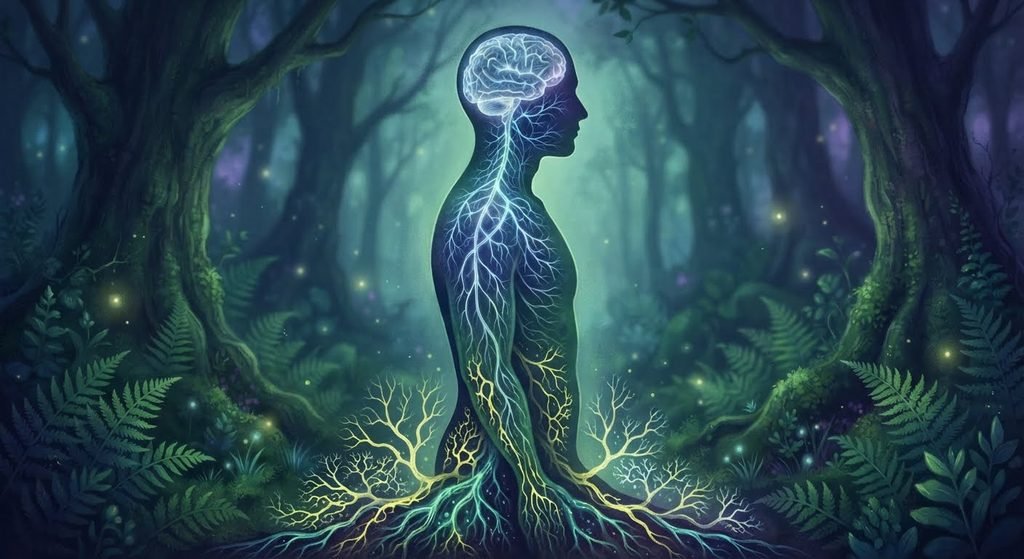
  • Slime Moulds: Despite having no neurons, slime moulds can navigate complex mazes, find the shortest path between food sources, and even anticipate periodic changes in their environment. They leave behind a trail of slime that acts as a spatial memory, helping them avoid areas they have already explored.
  • Plant Learning: Research has shown that plants like the Mimosa pudica can “learn” to stop folding their leaves in response to a harmless drop, remembering this lesson for weeks. Plants also communicate through root networks and chemical signals, adapting their growth based on past environmental stressors.
    In biology, this is often referred to as “basal cognition”—the ability to process information, adapt, and store physical traces of past events without a central nervous system. However, most scientists draw a clear distinction between this kind of biological information processing and phenomenal consciousness—the subjective, inner experience of “what it feels like” to be alive.
    Where Does Human Consciousness Come From?
    If plants and moulds can process memories without brains, where does human consciousness originate? Currently, there are two main ways of looking at this:
  • The Materialist View: The prevailing view in neuroscience is that consciousness is an emergent property of the brain. In this model, billions of neurons firing in complex networks generate our thoughts, feelings, and sense of self. Memories are stored physically through changes in synaptic connections.
  • Panpsychism and Non-Local Consciousness: Some philosophers and thinkers explore the idea that consciousness isn’t just produced by the brain, but is a fundamental feature of the universe itself—much like gravity or electromagnetism. In this view, complex brains don’t create consciousness; rather, they act like receivers or filters that shape a broader, universal awareness into a specific human experience.
    Stored Memories and Past Life Regression
    This debate often overlaps with personal experiences of memory, including practices like past life regression. During regression therapy—usually guided through hypnosis—individuals often recall vivid narratives, emotions, or sensory details that feel like memories from another time or person.
    From a conventional psychological standpoint, these experiences are typically understood as products of the subconscious mind, imagination, or cryptomnesia (forgotten memories from one’s current life resurfaced in a new form).
    However, within spiritual and philosophical frameworks that view consciousness as fundamental or non-local, these experiences are interpreted differently. If memory and awareness aren’t strictly locked inside physical brain tissue, some suggest that the mind might tap into a broader stream of consciousness or inherited ancestral memory.
    Bridging the Mystery
    Whether consciousness is strictly a product of complex neural wiring or a fundamental thread woven through all living things, studying how plants and moulds navigate the world reminds us that intelligence takes many forms. Exploring these questions invites us to look closely at the nature of our own minds, how we hold onto the past, and what it truly means to be aware.
Past Life Regression

  • Cellular Memory
  • Stored Memories
  • Subconscious Mind
  • Ancestral Memory
  • Spirituality
  • Mindfulness
  • Science and Spirituality
  • Nature Connection
  • Neuroscience

0 Comments

Submit a Comment

Your email address will not be published. Required fields are marked *

Related Posts

Using introspective hypnosis, uncover the mysteries that may lie behind your physical and mental issues. Uncover the unique essence within each of us that goes deeper than our personalities. 

Releasing old patterns and thought forms brings you back into alignment. Awaken your soul, encourage your awareness and protect your boundaries in particular situations. 

I work one to one or in groups and offer sessions online via zoom and Whatsapp. 

Understanding the past, healing the trauma in a safe environment, releasing pain, it is all part of the journey.

Releasing Attachments and Shadows 
Many people feel that there is something holding them back- but they are not sure what it is. Repetitive behaviours, irrational fears and phobias, emotional paralysis, and unexplained illnesses can all be manifestations of attachments and shadows – events and encounters from the past which continue to haunt us. 

My regressions can target and uncover these attachments and shadows and  help you to understand them, enabling you  to let them go, thereby healing past traumas. 

Past-horizons

Are you ready for your Journey? 


There is no way of knowing what you will experience during regression therapy.

People’s experiences can be very different. Some people may see glimpses of several past lives, whilst others may delve into one life in more detail, unearthing repressed memories that no longer serve them.

You may have been described by friends as an old soul or feel you have lived before. Some people can visit a place for the first time, yet instantly feel that it is familiar. Others speak of meeting someone for the first time yet feel as if they have known them all their lives.

A sound, smell, dream, or reaction to a situation can trigger memories of a past life experience. The smell of a perfume that your mother wore.

Some clients talk of souls that have chosen to reincarnate together such as partners, siblings, or friends to carry out tasks. An example would be a daughter who acts like the mother of the family or a strong connection with a relative who may have been your brother in a past life.

Some people may try past life regression out of curiosity, to see who they were in the past.

Others are in search of a path for personal growth and healing. Both are equally valid reasons for embarking on this therapy.

If you are feeling stuck in certain ways of thinking, feelings and behaviours, hypnotherapy can help enormously. It assists you in reframing negative thoughts and behaviours and encourages you to understand the reasons for this. It can help tip the feeling of loss upside down and allow you to view it in a positive way as you move to a higher understanding of situations. For example, instead of feeling like a relationship was a failure, hypnotherapy can help you see how the relationship helped you learn, understand, grow, and become more compassionate.

You hold the key to release yourself from past trauma, dreams and attachments from past lives locked in your memory. You will see things from a different perspective and realise you are more than what you see .
Opening the doors to past life records and working with them helps to release the chains of the past.  

As a client, you are fully awake and aware of everything going on around you. When I ask you a question, you have control of your mouth and body and express through words, what you are sensing (feeling, seeing hearing, knowing), what you are experiencing in your memory or what feels like your “imagination”.


To traverse through these memories, we discuss the issues that you would like to address at the beginning of the session.During my hypnosis sessions, there may be times when loved ones, lost souls, extra-terrestrials, or other beings have a message for my clients. You may just be curious but for those looking deeper for answers – there is soul work to do.